-
Duck Envy
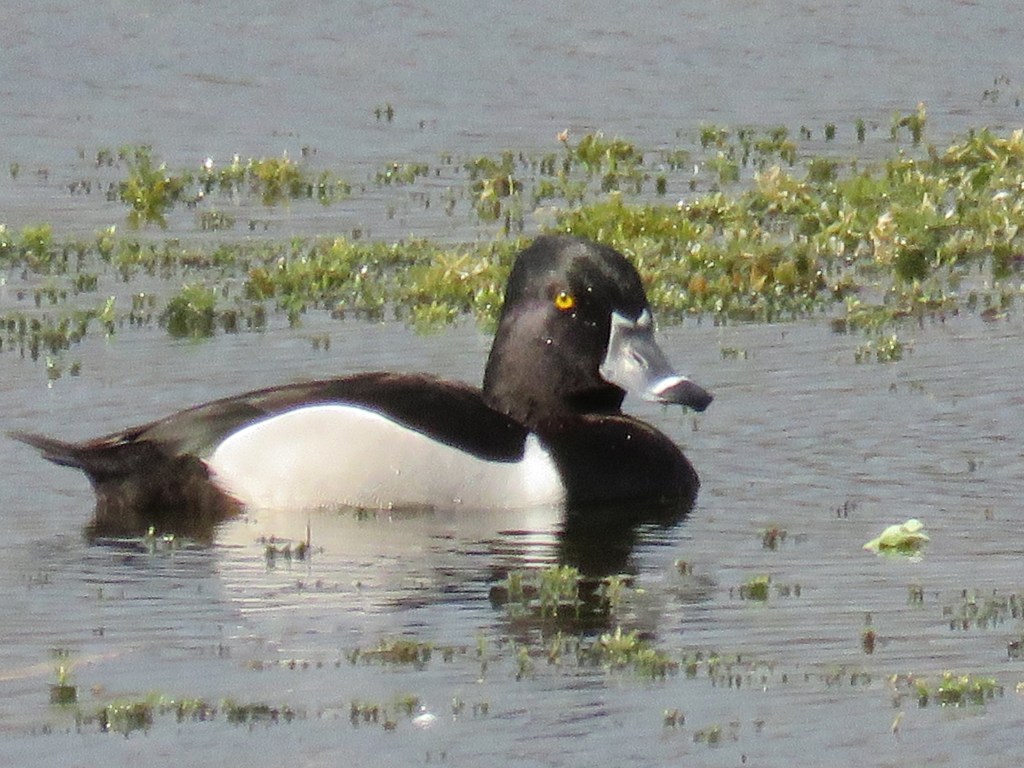
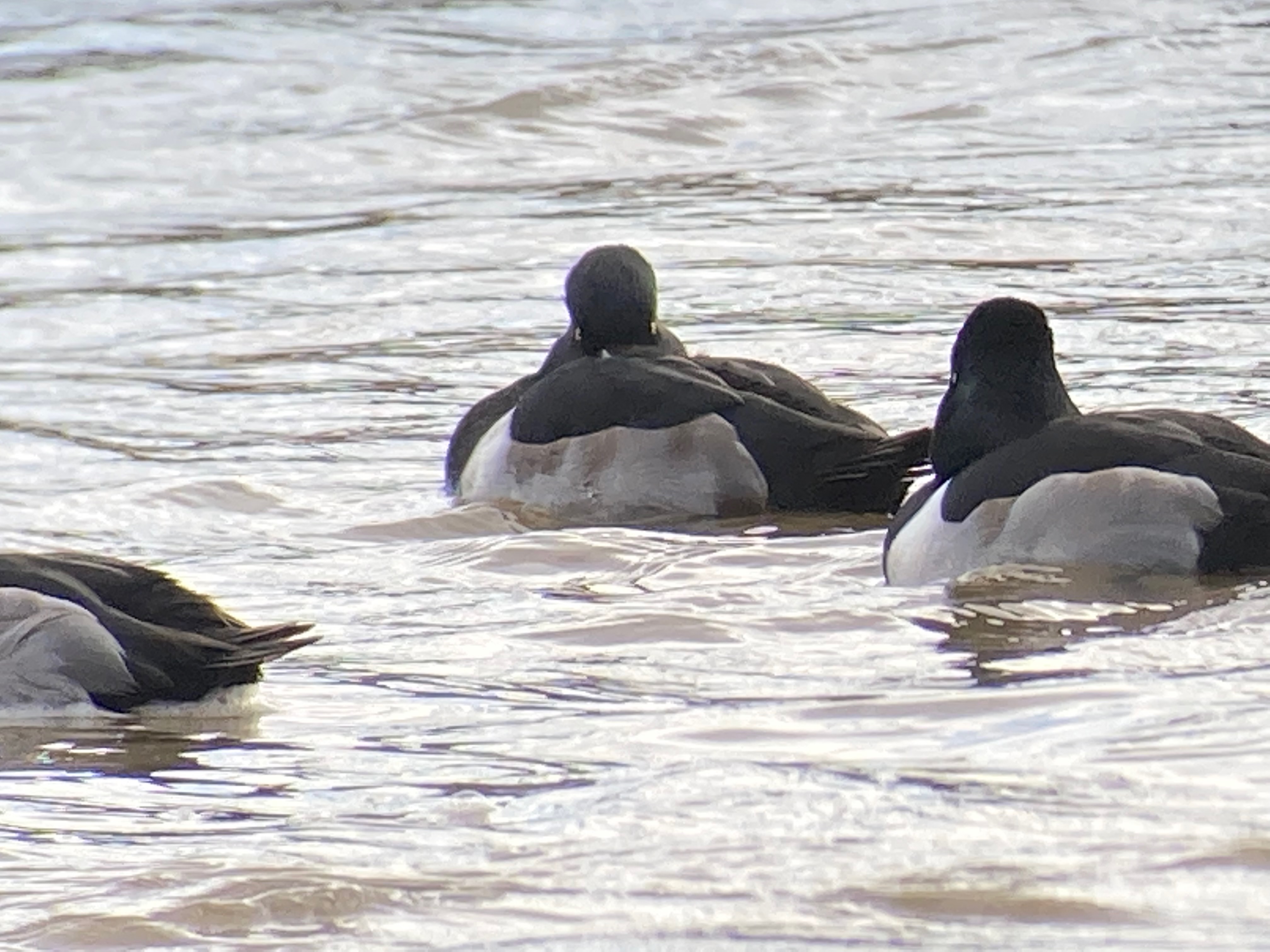
Ring-necked Ducks I love the wintertime. Not just because I enjoy cozying up in cold weather, although that’s pretty nice– and Luna gets extra cuddly too when it’s cold out. But my main reason for loving winter is that’s when lots of duck species show up in my area. Huge flocks (or rafts) sometimes show up in parks nearby, but really even just a few will give me glee. They’re weird and lovely and best of all, stay reasonably still most of the time. Very unlike the pesky warblers of spring and summer who hide in the treetops, obscured by leaves so I barely get more than a few seconds’ look.
instead, ducks will sit right out on the water, patiently letting me get nice long looks. I use a set of fold-out guides from Cornell Lab of Ornithology, for ID help. It’s a three-part series called “Where’s the White”— basically that on male ducks, you can identify the species just by paying attention to the white spots. (Females are not as simple, unfortunately.)
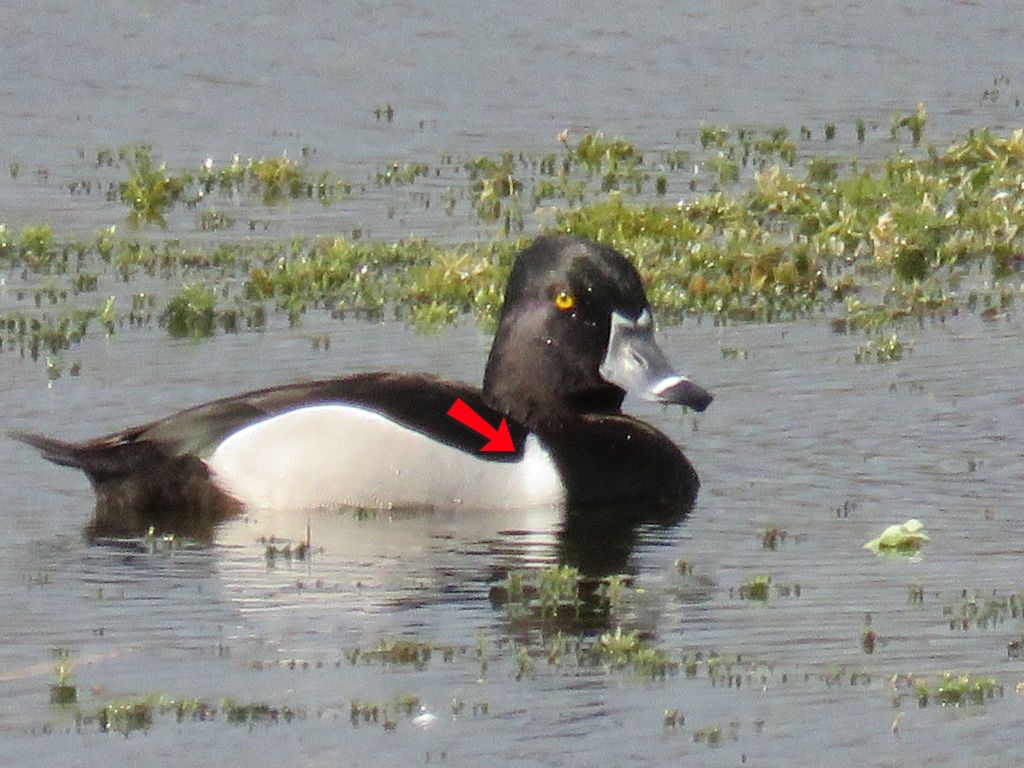
Another Ring-necked Duck, a red arrow indicating the diagnostic white mark Now, most of the time I just see dabbling and diving duck species near my house– like Bufflehead, Mergansers, Gadwall, and so forth. But I recently visited Maine for Thanksgiving, and my family rented a house right on the coast so we could all stay together. I managed to get out for a couple walks along the beach, and was overjoyed to see some nice chunky sea ducks. The goofier a bird is the more I like it, and sea ducks are some of the goofiest looking birds.
Scoters in particular are really silly looking. Male Surf Scoters have this great big bill, pied orange and white. They also have white spots on their black head, giving them the nickname of “skunkhead.” Male Black Scoters have a big yellow bulge at the base of their beak as well. White-winged Scoters, the kind I saw at Thanksgiving, have a Nike swoosh-shaped white mark under their eye that I think makes them look very goth, like dramatically winged eyeliner.
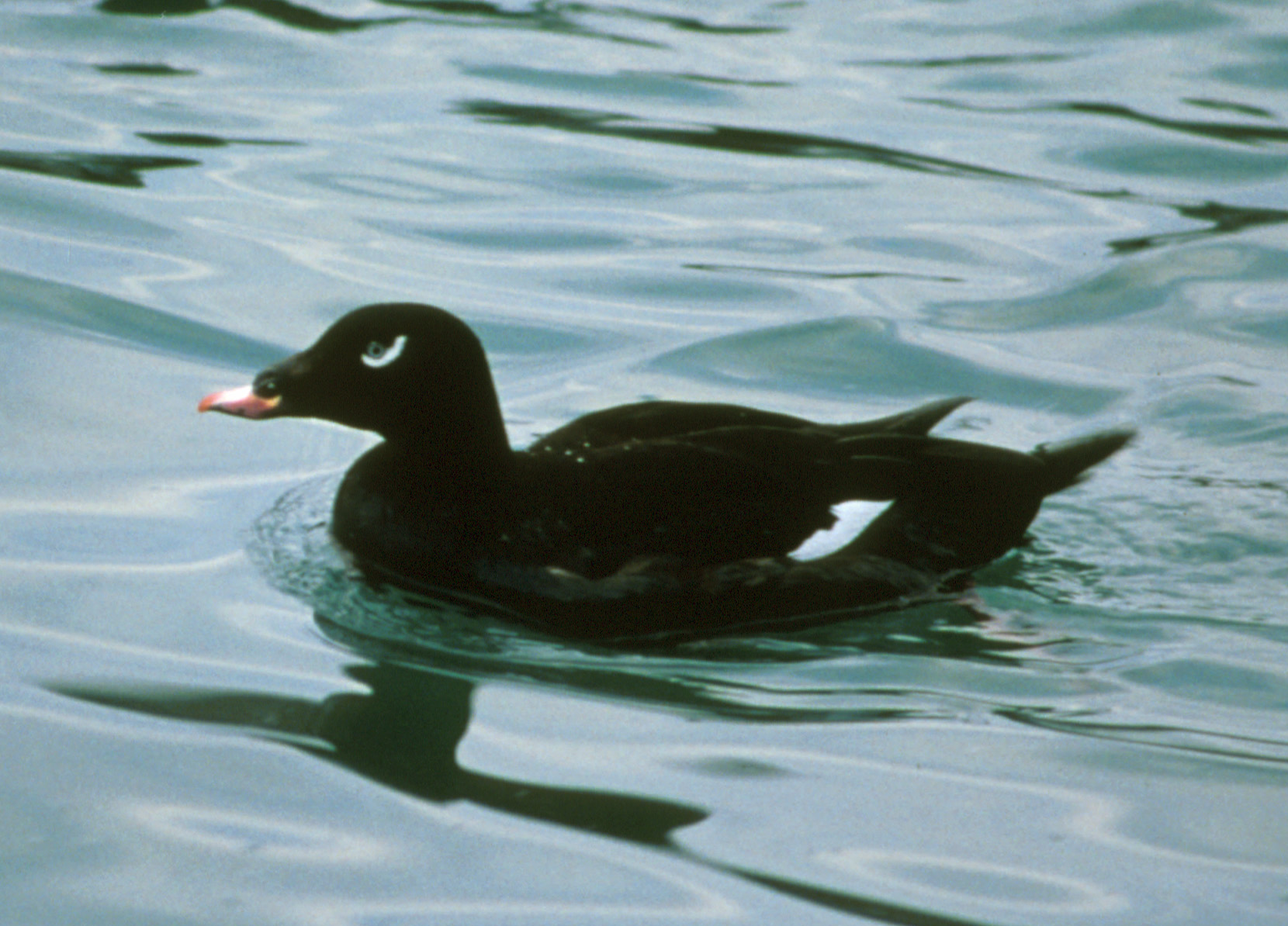
White-winged Scoter, photograph by David Menke, Public domain, via Wikimedia Commons I also saw Common Mergansers, like the one below– I can see them at home this time of year as well. But I don’t get to see Common Eiders at home, and they were in abundance among the offshore waves in Maine. Eiders are really neat birds, they have very well-adapted down feathers that keep them warm. That’s what lets them live far north in the northern Atlantic and the Arctic oceans– the insulating feathers keep them warm, and eider hens also pluck down from their own breast to build warm nests to incubate their eggs. In fact, people still harvest that down for use in (very expensive) comforters and jackets today. Supposedly eiderdown is the warmest in the world. Eider chicks are precocious and leave the nest just a couple hours after hatching, so humans can easily gather the down without hurting any birds. But of course that’s a very time-consuming endeavor, to gather enough down for a whole jacket or comforter. Most of our down products these days use feathers that are a byproduct of the duck and chicken farms that give us meat and eggs.
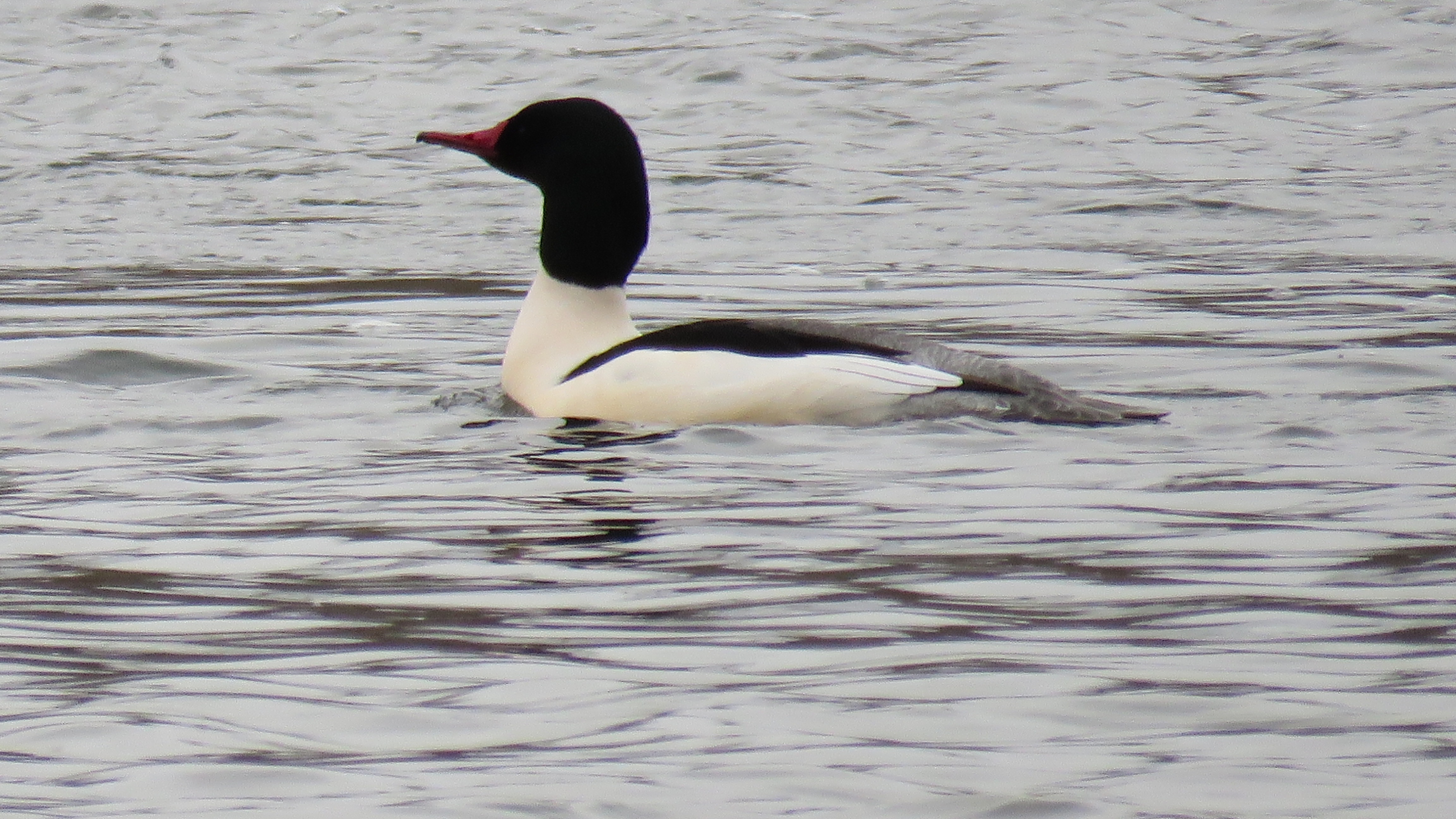
Male Common Merganser But winter ducks don’t just look silly, they act it too. My absolute favorite duck species is the Hooded Merganser. These I can see in my area, in fact there are a couple spots they even breed locally although their winter population is much larger when migrants arrive. So I’ve had a lot of opportunity to observe these birds, starting from the very first park I worked at (Mason Neck State Park). During the winter, ducks often engage in courtship rituals. And Hooded Mergansers are quite flashy. Males will swim around with their crests raised, pumping their heads back and forth to try to impress females. Usually, though, the females seem completely unimpressed (at least so much as I can interpret cross-species). That kind of cracks me up, the clowning and strutting around.
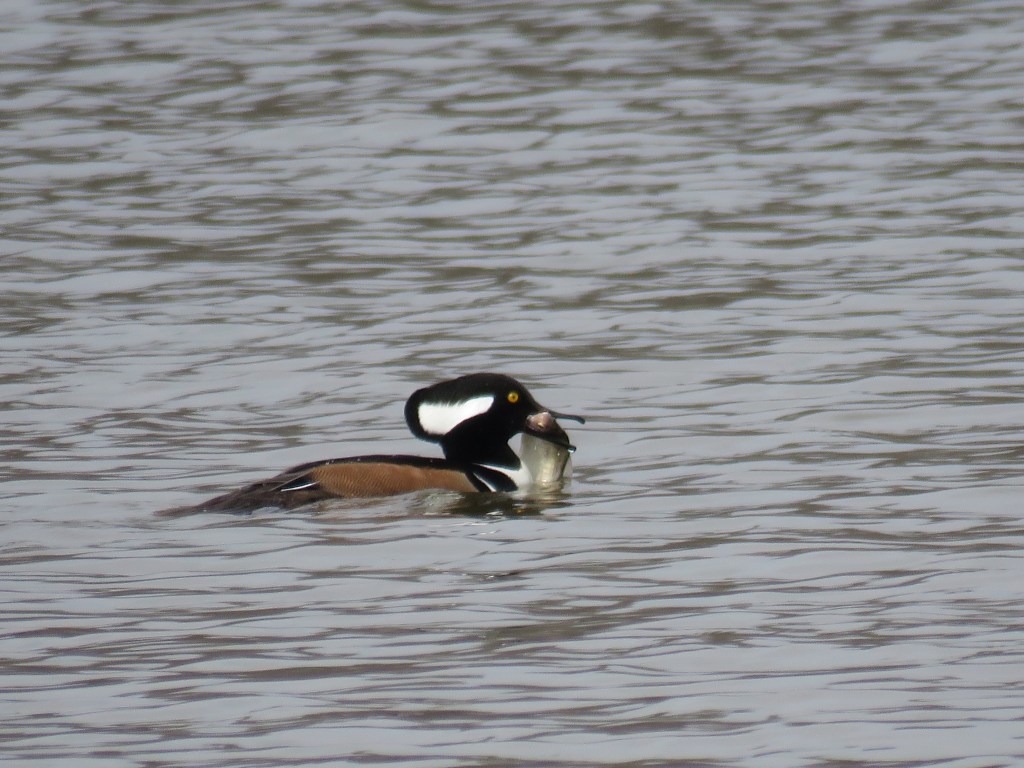
A male Hooded Merganser valiantly trying to swallow its fishy lunch But there’s another kind of duck I haven’t yet seen, either near my house or when visiting Maine. It’s one of the weirdest-looking ducks of all– the King Eider. Male King Eiders have a red beak, a giant orange patch over their beak, a green cheek and a gray forehead, above a more ordinary black and white eider body. I’ve always wanted to see one, but they are not common even along the northeast coast of the US in wintertime. Occasionally one gets spotted off Maine, but so far not while I’ve also been in the area.
Someday I hope I’ll get to see a King Eider in the wild. Maybe someday I’ll even move closer to the ocean, where I can watch silly sea ducks to my heart’s content this time of year. Until then, I’ll make do with the slightly less silly dabblers and divers, and resign myself to a sad case of duck envy. Honk!
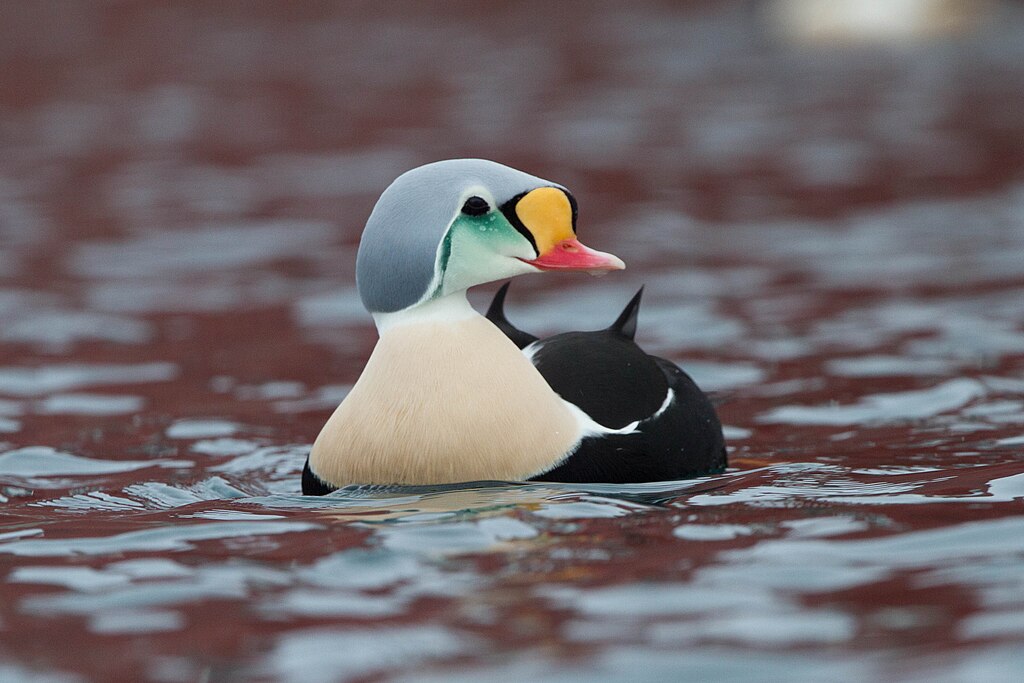
King Eider photographed in Norway, courtesy Ron Knight from Seaford, East Sussex, United Kingdom, CC BY 2.0 via Wikimedia Commons
-
Feeling Like Snow White
I recently had what I’d call a Snow White moment, one that feels so magical it was like the scene in Snow White where she sings to the forest animals:

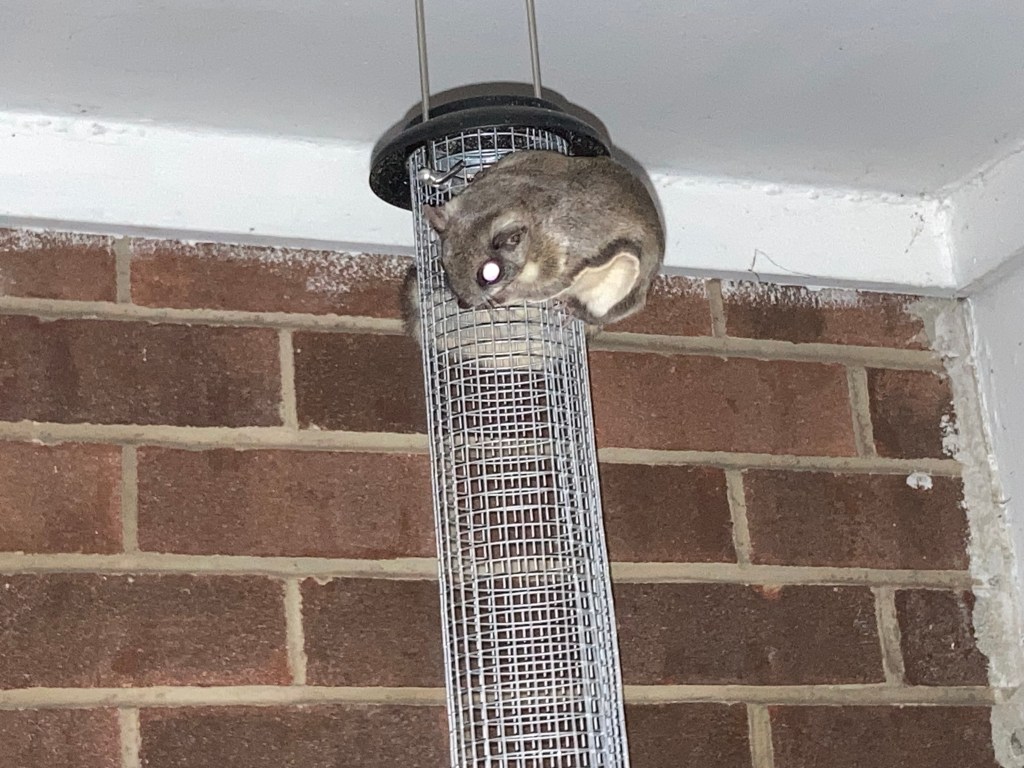
Snow White and the woodland animals, uploaded by Ethan Partington, aka Ethanimation. Via https://www.disneyclips.com/images4/images/snow-white-animals5.png I was sitting in my living room, probably reading or playing a game on my phone. Luna was insistently scratching at the sliding door onto my balcony, begging to be let out. But her attention seemed directed at a different spot than usual, not down on the floor of my balcony where mice sometimes forage for dropped birdseed at night. Instead she was looking up, at the feeder itself. So I glanced that way when I went to open the door for her. Much to my surprise, I saw a small furry critter clinging to the brick wall behind it. A flying squirrel!!
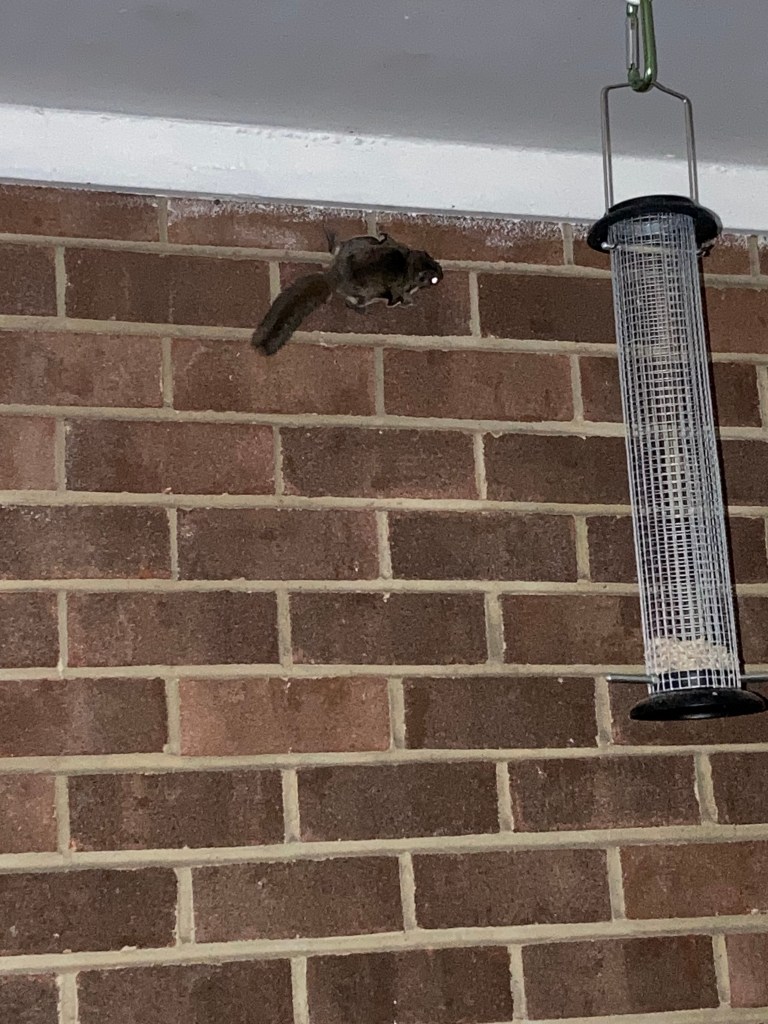
Almost everybody I tell this story to has responded, “I didn’t know we had flying squirrels around here!” I was aware we had them in the area, but not in my specific neighborhood. A couple years ago I attended a nighttime program at Brookside Nature Center where we watched flying squirrels come to their birdfeeders. I thought I’d written a post about that, but can’t find it right now. I also experienced a flying squirrel up close once when I worked at the Maryland Rennaissance Faire. The jewelry booth where I cashiered had a flying squirrel hide itself under the cash register counter one morning. We hung a cloth over the shelf to give the little critter as much dark and calm as we could, despite the hustle and hum of the faire. It was so cute, with those big dark eyes! I struggled mightily to resist peeking behind the cloth. Eventually, after faire was done for the day and the sun had set, my boss coaxed the little beast out and it scampered to a nearby tree.
So I knew there were flying squirrels in our general area, but I never dreamed I would be so lucky as to have one visit my own feeders! Later this same evening I even saw one perched on the feeder itself. That time I was notified not by Luna but by the sudden violent swinging of the feeder after the squirrel landed on it. When I peeked out, I found the squirrel clinging to my nearly-empty bird feeder. (Oops!) I silently promised I’d fill it in the morning.
The squirrel’s eyes seem to glow because they are so well adapted to night-time, they reflect almost all of the light they pick up. Same kind of thing you see with cats’ eyes. I did put more seed out, but didn’t spot the squirrel again for a few days. Then a few days later I saw the feeder swinging again and this time I could make out not one, but two flying squirrels clinging to it! So I know there are at least two flying squirrels living in my neighborhood. Yay! Of course, flying squirrels are more accurately called gliding squirrels, as they glide from tree to tree catching air with their patagium, or the extra fold of skin they evolved that stretches from wrists to ankles.
Discussing this with some of my friends and coworkers made me start to wonder about how closely flying squirrels might b e related to gray squirrels. Also, I wondered why a whole group of species might somehow branch off and not only develop a new way to move around, but also shift their active period entirely.
What I found out was that as the predecessors of our flying squirrels developed their gliding membrane, that made them less nimble on the ground. So they were more in danger from prowling predators. Over time, they shifted to becoming active at night to avoid those hunters. And eventually they evolved the large dark eyes we know them for, as it makes it easier to see in the dark. There are certainly still nocturnal predators they must watch out for– great horned owls I’m sure, and foxes if the squirrels come down to the ground.
And apparently, flying squirrels will immediately hide on the other side of the tree trunk they just landed on, in case an owl or other predator followed them. Pretty smart! That seems to be reminiscent of gray squirrel behavior too, I know many times if I spot a squirrel in the woods it will flee up a tree and hide on the opposite side, occasionally peeking out. I wonder if that’s an inherited trait, from their common ancestor, or simply the most efficient way to use the tree as a defense, or both? I think some woodpeckers occasionally do that too– hop around so they’re on the other side of the tree from me. Others will just freeze and hope they blend in well enough. Hmm. Several strategies for tree-dwellers.
I would love to get a game camera and direct it toward my birdfeeder at night. Especially if it had night vision, aka infrared. But that’s not a priority for my budget right now. Maybe in the next year or so. And then, perhaps, I’ll write another post about flying squirrels!
-
Monhegan Island Wildlife
[Note: this post was originally written in 2023, and now a year later I’m finally posting it while back at Monhegan!]
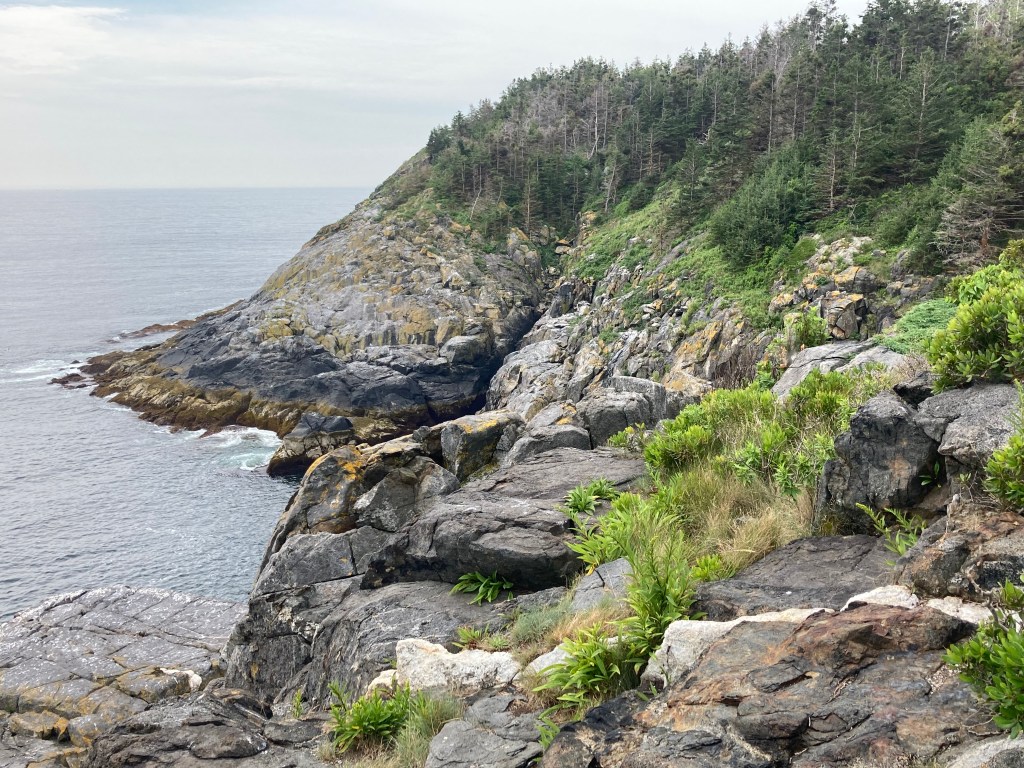
I’m spending a week with family on Monhegan Island, ten miles off the coast of Maine. The habitat up here in Maine is much different from the warm, moist Mid-Atlantic where I live. There are so many pine trees and other evergreens here! The forests are full of lush banks of moss, tangles of lichen, and hordes of mushrooms. Apparently it’s been raining a lot of the summer this year locally, including in the last few weeks, so there were plenty of mushrooms along some of our favorite trails on the island. Also a lot of biting flies on some of the cliffs, unfortunately. The views were worth it though.
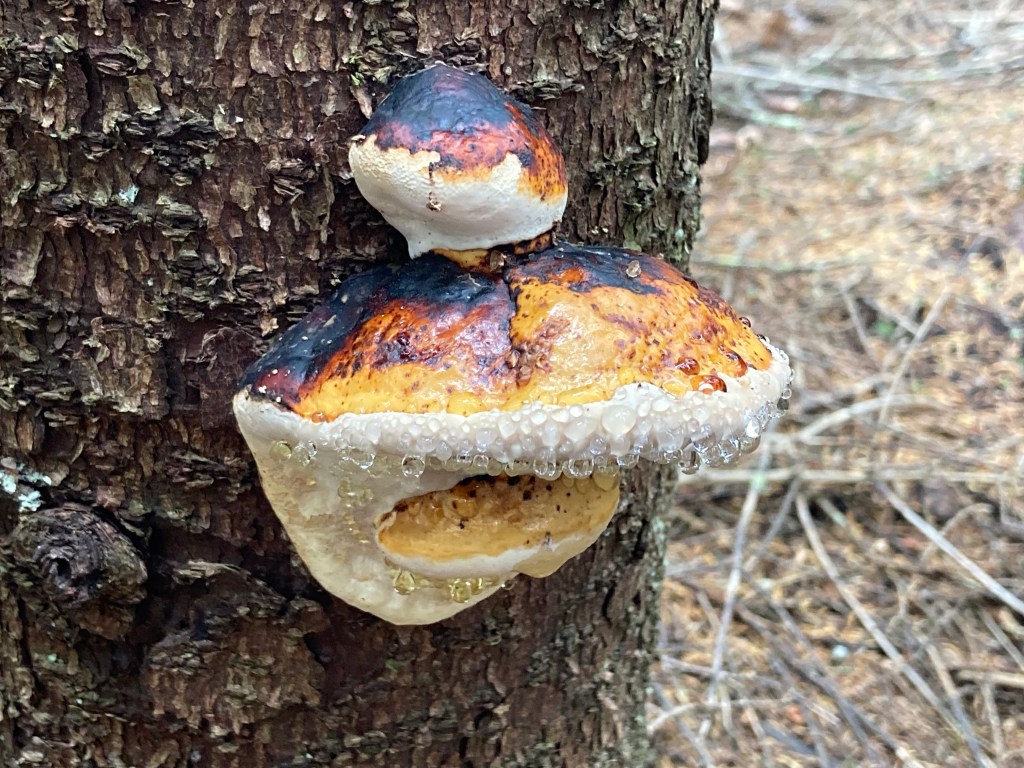
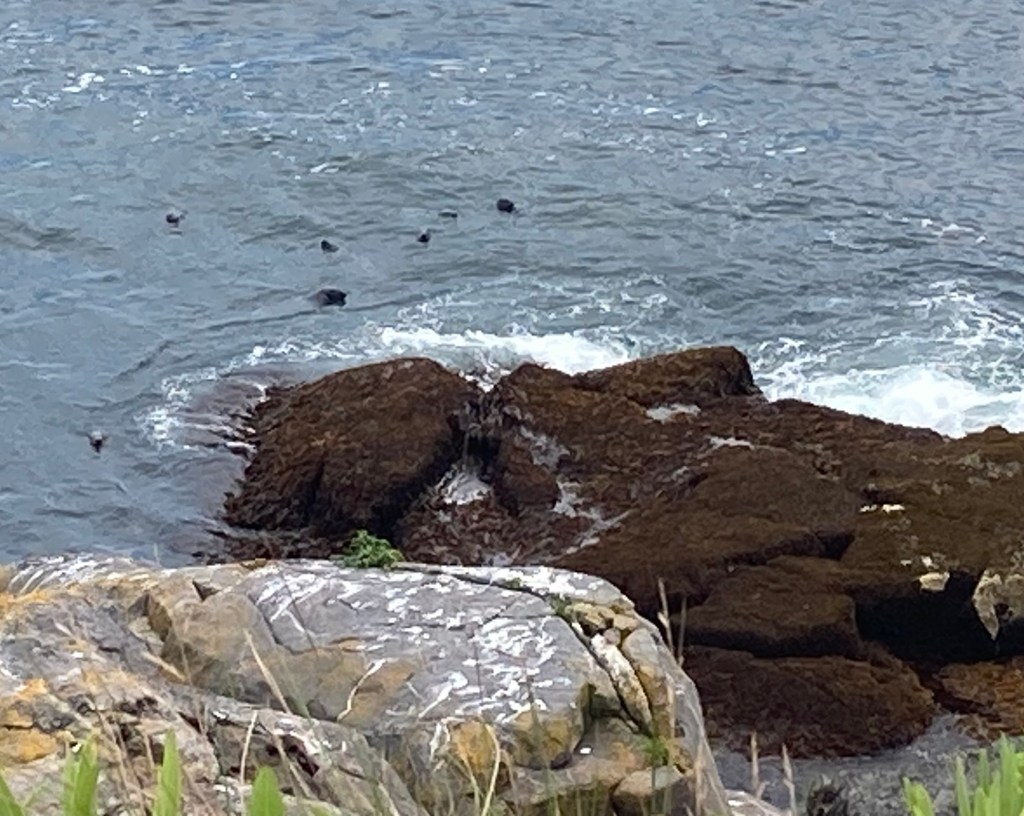
This polypore is probably in genus Formitopsis. Exuding beads of moisture like this is called guttation — see a fascinating blog post athttps://weirdandwonderfulwildmushrooms.blogspot.com/2014/08/read-it-and-weep-fungal-guttation.html for further discussion and photos. When we hiked up to Pulpit Rock, we saw about 10 gray seals bobbing in the surf, along with a single, much smaller, Harbor Seal lounging on one of the rocky outcrops. While admiring the seals, I suddenly noticed more movement among the barnacles and seaweed near the Harbor Seal. A closer look revealed several beautiful Ruddy Turnstones scurrying around! They were in summer plumage, something I don’t normally get to see if I spot them in my area– they might come through on migration so they’re already in winter plumage by then. But these were bright and fully ruddy. I wished we were closer but at least my binoculars allowed me to get good enough looks. No photos though, we were too far for my cell phone camera to zoom effectively.
That wasn’t the only notable bird observation I had this week that didn’t have photographic evidence. On Sunday afternoon, we were enjoying sunshine on the deck and reading books from the village library, when I heard an interesting “Tseep!” I looked up and noticed a small yellowish bird at the top of the spruce tree. I got my binoculars on it and discovered it had a funny looking bill. I instantly hoped I had a lifer, a crossbill– but wanted to make sure. It could have been some other kind of bird with a beak deformity that made just one mandible grow longer than normal. So I watched it until I got a good view of the beak tip. And indeed, both mandibles crossed, I did have my first-ever crossbill! I looked it up once the bird flew away, it was a female Red Crossbill. I didn’t even have to chase it; it’s so nice when the lifers come to you!

The next day, we all walked down to one of the village bakeries to buy some croissants for breakfast. Once we got back and were seated on the deck, I kept an eye on the spruce tree. Eventually a pine warbler showed up, and hopped around through the branches, gleaning tiny insects off the bark. It was a lot of fun to watch. Suddenly, there was a burst of activity in the inner branches, then the warbler emerged pursued by a larger bird- a kestrel! The kestrel chased the warbler around and into the tree, then emerged with the tiny bird clutched in its talons. As the kestrel flew off, a tiny grey and yellow feather drifted down to our table. I later taped it into my journal as a memento. Wow!
-
Island Library
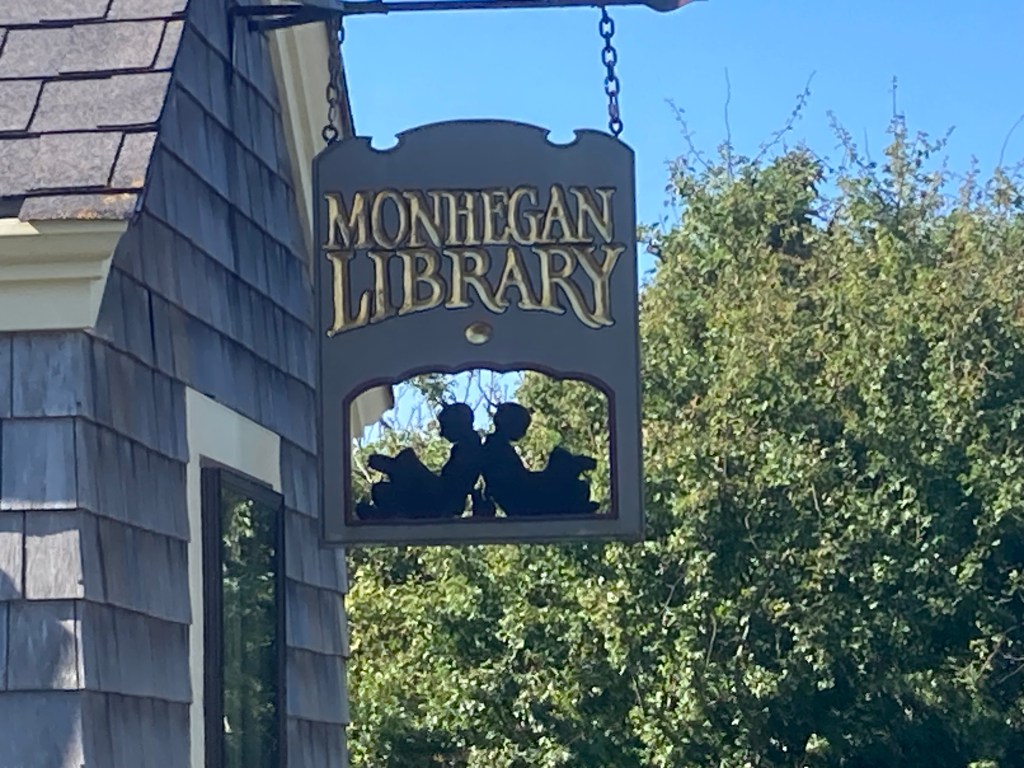
My vacation booklist
There’s a certain kind of book I really like to read on Monhegan Island family vacations. I like them other times as well, but I specifically gravitate toward this when I’m here. We always make a trip to the island library as soon as we arrive, to pick out books to read during our vacations. Whether it’s while lounging in the sun, or inside while a storm rages outside, or as I’m winding down at the end of the day. And sometimes, if I have disagreements with family members or something else is disturbing me, it’s nice to have an excellent book to lose myself in.
So far the books in my particular island group include:
- Naomi Novik’s Scholomance series–
- A Deadly Education
- The Last Graduate
- The Golden Enclaves
- Thistlefoot, by GennaRose Nethercott
- The Library of the Unwritten, by A.J. Hackwith (book 1 of the Hell’s Library trilogy)
Magic & reality
These books all mix magic and real-world settings or actual folklore. Thistlefoot, for example, takes the story of Baba Yaga and her sentient chicken-footed house, and spins a mystical tale that merges Eastern European folklore, present-day USA, and siblings healing from multi-generational trauma. The Scholomance series describes a school where students learn magic, mixed with typical coming-of-age tropes, and what happens when the person or thing you trusted most tries to destroy you. It feels very much like a rich fairytale, with amazing worldbuilding. The Library of the Unwritten describes the adventures of Claire, librarian of a very unusual collection: unwritten books. In the story’s world, all books that have not yet been written, or never will be, reside in this section of Hell. Some books might still be written, if their authors can heal from what’s blocking them for example. Others never will be since their authors are long dead. They exist in potential– they could have been written.

It’s hard to explain what else links these stories for me, other than a general gist. The particular feel of the just barely outside of the real world– the protagonists aren’t kings or queens or magical beings like fairies. They are relatively ordinary people, or at least they think they are. Yet they’re existing in this magical world. I think all these stories come under the subgenre of Urban Fantasy. Or at least, they’re cousins of Urban Fantasy.

One thing I love the most about all of these stories is the transformation from an ordinary setting (a library, a university, modern USA) into something new and strange, beautiful even if frightening. That mindflip represents what I want a vacation to be– something transformative, a special time and space where I have stepped away from the real world. It still exists alongside my vacation time, of course, and I may even still check the headlines daily. But I don’t have to worry about the usual concerns of work, community politics, international events, and so on. I feel like I’m in a separate pace where so much potential exists, and is mine for the taking. Free of those usual burdens I can start a new habit, revise my normal routine, try something new and unknown.
So the characters’ transformative journeys speak to me in particular when I’m in family vacation mode. I’ve only achieved this feeling on Monhegan trips so far– when I take a whole week away from my normal life. That’s long enough to think of something new and try it over and over. It might or might not stick, that’s part of the mystery that enchants me.
Transformation
When I visit the Monhegan library upon my arrival at the island, I might not even remember that’s the kind of book I’m looking for– until I find one. Or I see one of the books I read in this same group before, that reminds me. Then I keep it in mind while I look through the fantasy & sci-fi section. I may take out other sub-genres as well, as I did this year, but I’m hoping for the urban fantasy transformation that will echo my own hoped-for changes.
Dissonance and creation
Reading on Monhegan is different than reading anywhere else I go, also. I’m just as enraptured as usual by an author’s worldbuilding. But at the back of my mind I also hear dozens of gulls squawking, ocean waves lapping on the rocky shore, and an approaching ferry’s motor growling. At home I live a couple hours’ drive from the ocean, so this is nothing like what I’d hear on a normal day. It’s a dissonance between what I know is reality (work, normal politics, etc) and what I can hear, feel, and see right now.
Even if I don’t do deep transformations on these vacations, I still feel like I’m doing a lot of inner work. Much like letting an injured limb rest while your body heals, I’m tuning out the stress and fright and terror associated with daily life. That recovery is so important. On the outside, it might seem like nothing has changed as soon as I return home and head back to work. But on the inside I’m stronger and more resilient. And perhaps I’ll have a realization about, for example, how much energy I give to the horror stories of modern events, instead of creating my own imaginative story. Perhaps the simple act of reading more, writing more, being creative and unstructured, will have reawakened my own creative yearnings enough for them to stay present when I get home. Who knows where that might lead me?
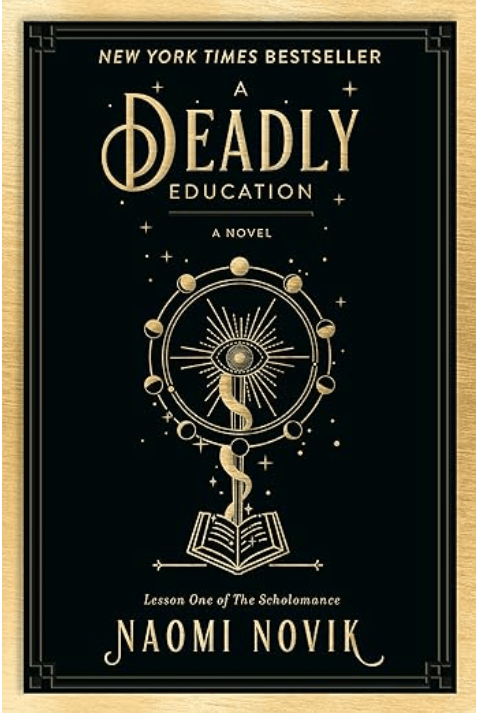
- Naomi Novik’s Scholomance series–
-
Lichen With Legs?!
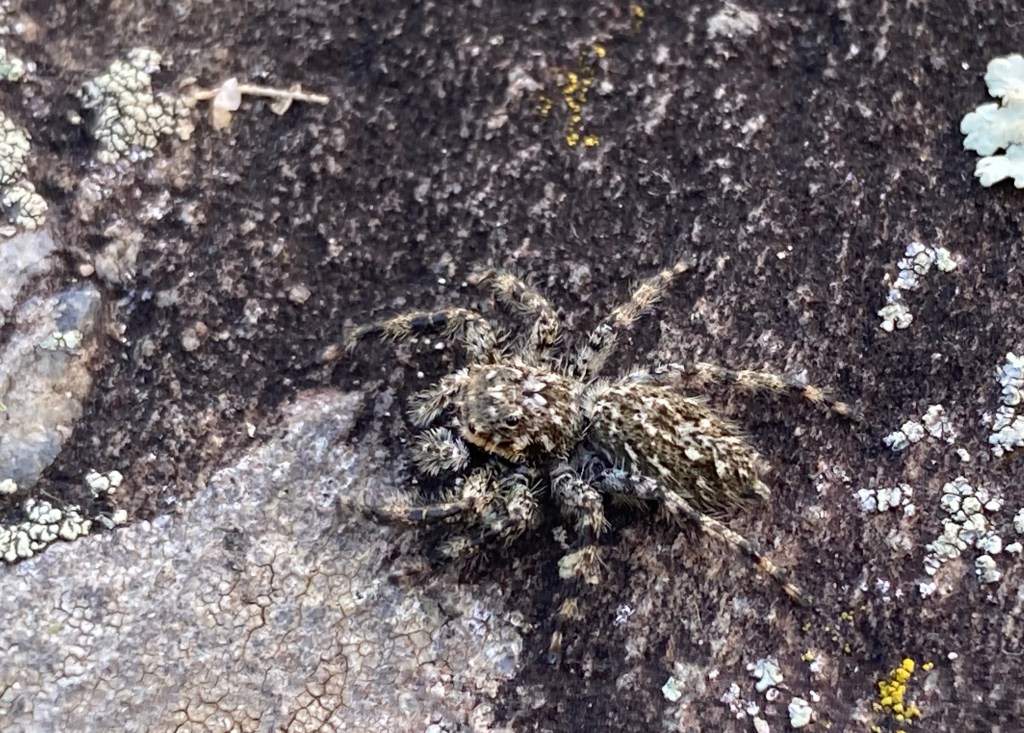
At work, one of the places I monitor for visitor safety has a huge wall of solid stone that I have to peer over. It’s too tall for me to clear easily, but there’s a chunk of quartz that protrudes from the wall and makes a fine foothold to give me a boost. As I step up, I also put my hand on the top of the wall to haul myself up.
The rock is covered with interesting lichens; I’ve posted several of them on iNaturalist . But one day as I hauled myself up the wall I noticed a bit of movement near my hand. A little patch of what I had thought was another lichen, had legs! Looking more closely, of course it wasn’t a lichen, but a very furry little jumping spider. This individual’s camouflage was just about perfect for the rock it was on– I was fooled for sure, I bet hungry birds and other predators (like lizards) would be too. Wow!
So moving very slowly, as I kept my grip on the top of the wall, I pulled out my phone and snapped a quick series of photos. Then (of course) I said to the visitors nearby, “Hey, you wanna see a really cool spider?” To my delight they said yes, and we all proceeded to admire the spider, and marvel how well camouflaged it was. If the spider could have understood us, i imagine it would have thought, “Stop calling attention to me already!” Eventually it had enough of us and scurried a little farther away. By now my toes were starting to ache as I balanced on the quartz point anyway, so we bid farewell to the spider. Later I identified it as a Tan Jumping Spider (Platycryptus undatus), using both iNaturalist and our Natural Resources staff.
Looking back through my iNaturalist observations, this is at least the fourth species of jumping spider I’ve found at my park. I think jumpers are really cool, cute little beasts (often furry like my “lichen”). If you’ve ever seen the cartoon “Lucas the Spider,” that’s a jumping spider too.
Of all of the jumping spiders I’ve seen so far, this individual is definitely my favorite. Look at all that fluff! Even its little pedipalps are bristly. Very effective at disguising the brutal predator lurking behind the cuteness. I imagine the bristles help break up the spider’s outline, as well as make its texture look like the craggy bits of lichen on the rock nearby.

About Me
The sky is not completely dark at night. Were the sky absolutely dark, one would not be able to see the silhouette of an object against the sky.
Follow Me On
Subscribe To My Newsletter
Subscribe for new travel stories and exclusive content.