-
Ground-nesting Bees

Every single one of these tiny earth hills was created by a ground-nesting bee while excavating the tunnel where she’d lay her egg on a ball of pollen. A couple weeks ago at work, one of my coworkers mentioned he had found the largest group of ground-nesting bees he’d ever seen, right behind our office. I peeked out the window but couldn’t see anything. When I went outside, though, I finally saw what he meant. There were hundreds, maybe even thousands, of little hills of earth in the dry grassy field behind our buildings. Each one had a tiny hole in it, and as I watched there were very many tiny bees flying over them, going into or coming out of them. It was so cool!
Don’t Worry
Before you start to panic on my behalf, let me reassure you. These bees had absolutely zero interest in me. I have stood in the middle of a field of ground nesting bees’ nests before, with the bees actively buzzing around me going to and from their nests, and received not a single sting or even one bee landing on me. What a lot of people think of when they imagine bees in the ground are actually wasps, yellowjackets, who have communal nests in the ground and are notoriously bad-tempered (especially when someone accidentally steps on their nest, I mean wouldn’t you be?). But these bees I encountered are truly bees.
There are a lot of different kinds of bees that nest in the ground like this. I only had my cell phone with me, so didn’t get fantastic shots. That detracted nothing from the experience, though, just meant I may not be able to identify to species level. They’re probably some kind of mining bees, family Andrenidae. They’re small, fuzzy, and won’t hurt you– basically flying teddy bears! Well, maybe that’s an exaggeration, but I still am fond of them.
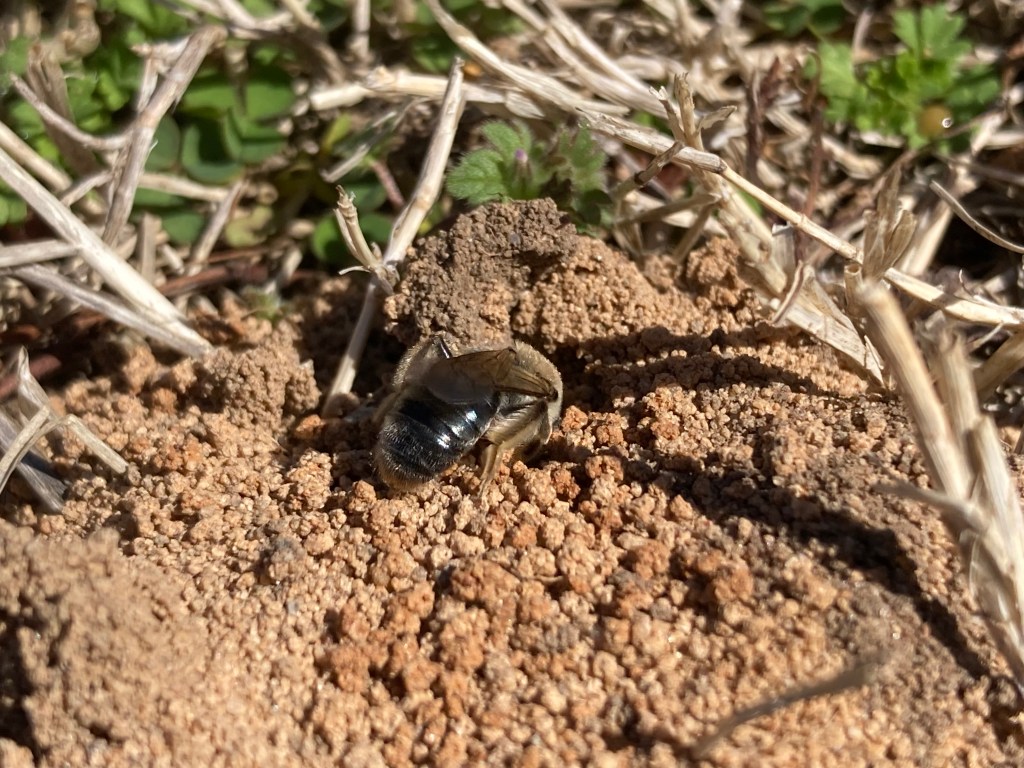
Busily digging 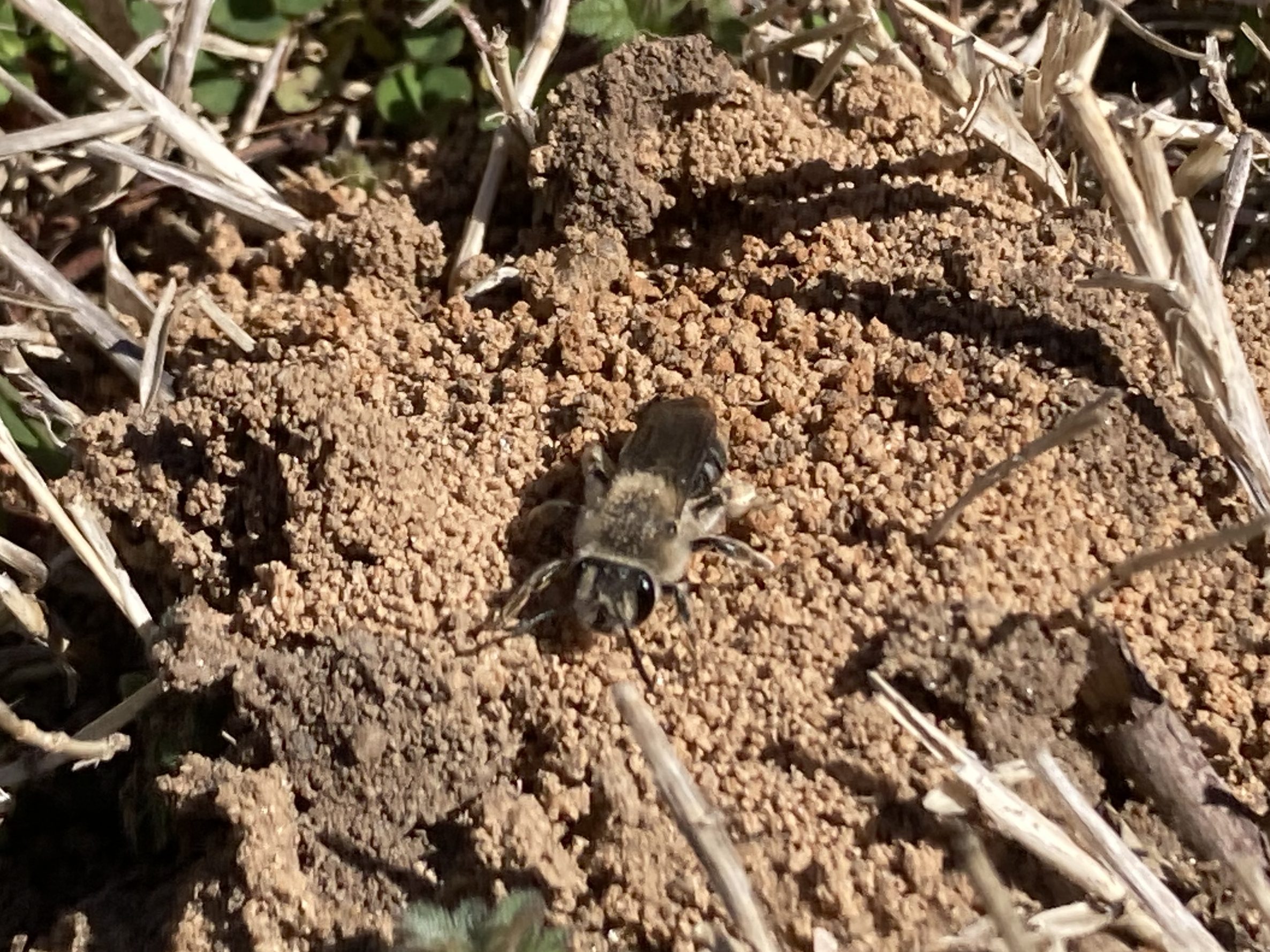
Look at that cute little face! And I agreed with my coworker, I had never seen this many nests congregated before! It covered nearly the entire field behind our office buildings. I suppose it was just the right kind of soil, and the right level of moisture– and since most of the rest of the park is ponds or marsh, maybe that specific combination is not easily found. What a treat for us! And even more special, some (maybe most?) species of these bees are active for only a few weeks in the early spring. Once they’ve mated and the female has dug her burrow, and laid her egg(s) on a ball of carefully-gathered pollen, that’s pretty much it for her. The baby bee doesn’t leave larval form until early next spring.
Interdependence
And that timing is why many of the Andrenids are highly specific about what kind(s) of flower they need for pollen to feed the growing larva. There aren’t a whole lot of plants blooming yet, so early in the spring. But the kinds of flowers known as spring ephemerals are out! These are forest-floor plants that bloom only in the early spring, when the sunlight can still make it through the as-yet-unleaved branches of deciduous trees. In my area, ephemerals include Spring Beauties, Dutchman’s Breeches, Bloodflower, Virginia Bluebells, and Cutleaf Toothwort. By the time the trees are fully leafed out and cast the forest floor into shade, these plants have gone dormant again, as have the Andrenid bees. I know of at least one kind of bee in my area that’s completely dependent on a single species of flower– the Spring Beauty Bee. I have seen bees at the flowers of Spring Beauties, but I don’t know for sure whether I’ve seen that exact bee.
This year, I haven’t seen very many ephemerals blooming in my new park compared to Great Falls, which I left a few months ago; but I haven’t roamed too far beyond the ponds yet. My guess is there are more ephemerals a little further away from the pond area, where the forest is more dominant. But it’s still early, so we will see as the season progresses. (As I get ready to publish this, I’m also coming off a week and a half of being sick and cooped up in my apartment, sigh. Even if I missed the ephemerals there are still lots more blossoms to come.)
Resources
For more information about ground nesting bees, or native bees specifically in the MidAtlantic area, here are a couple places to start–
Publication from the excellent USGS Bee Lab located at the Patuxent Research Refuge in Maryland– https://www.usgs.gov/centers/eesc/quick-background-mid-atlantic-regions-native-bees
Info on a demonstration/display in California, and the life cycle & habitat needs of California ground nesting bees– https://www.miridae.com/the-ground-nesting-bee-project
-
Ranger Life
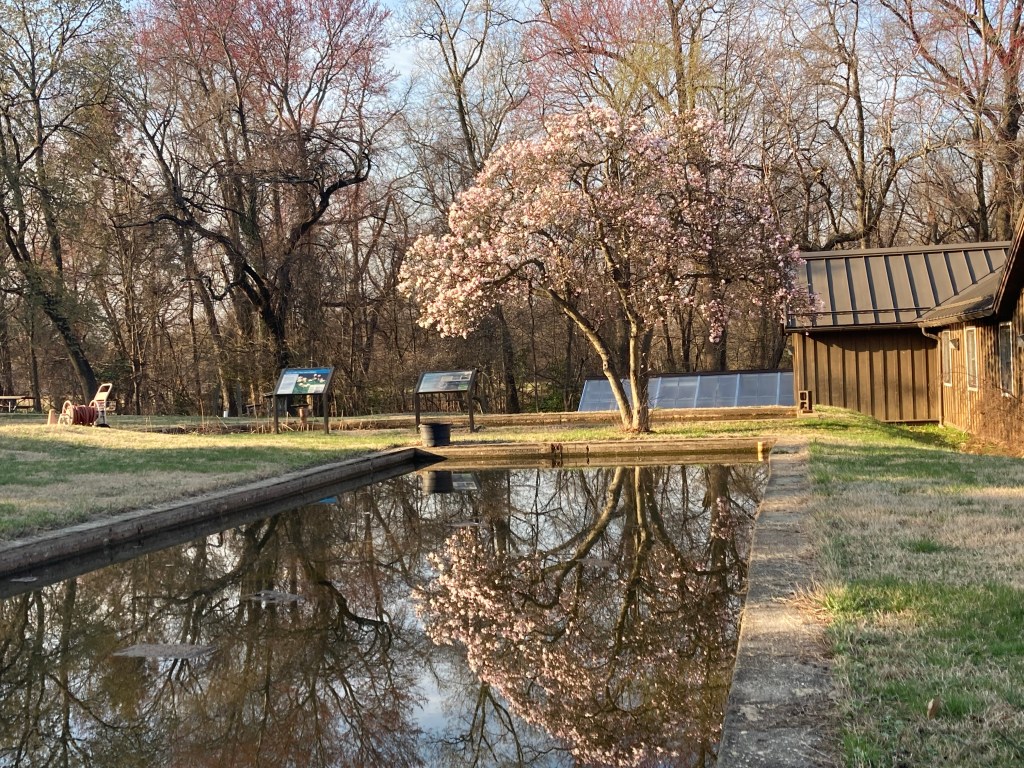
One of the scenes I get to see at work– there will be lilies or lotuses in this pool eventually but not yet. It still reflects the cherry blossoms beautifully. One of the central parts of my job is opening the park every day. All of us who are on duty for a given day unlock the gates and then make our way to the Visitor Center. Once we’ve opened our offices and deactivated the alarms, we go on a walk around the ponds and the boardwalk. This is when we check in for what’s on our plate for the day, and also look for any interesting birds or other wildlife. We’re not necessarily the *first* ones out, it’s possible to enter the park via the river trail– and some of our regular birders do that so they can check things out at dawn. But we’re usually at least *one of* the first groups out.
I like watching birds go about their morning– little sparrows searching through the grass for seeds, hawks searching for those little sparrows, ducks waking up and quacking contentedly to each other. And of course the Canada geese making a ruckus about nothing at all. It’s the beginning of migration season right now, so there’s sometimes a new species that we hadn’t seen before, or perhaps it’s the last day we’ll see a different species until fall. I saw some rusty blackbirds in one of the maple trees recently. At first all I could see was a black bird, but I knew the weekly bird walk spotted some rusties a couple days before, so I took a closer look with my binoculars. The warm sunlight glowed off its face, highlighting the telltale lighter stripes, letting me know for sure I had my own rusty. Yay! Later that same walk I encountered a birder from Finland who was racking up lifers on his visit to our country. After he gleefully saw (and heard) his first-ever Fish Crow, he asked if there were any Rusty Blackbirds around. Talk about the right timing! I pointed him to the exact tree where I’d seen mine. No guarantee it would still be there, of course, but that would be a good spot to start searching.
The end of our day isn’t usually my favorite. We close the park at 4 pm, and often have to shoo out lingering (or even just-arrived) visitors. That’s awkward and uncomfortable. Usually people are good natured about it so far; I feel guilty though. Later this summer we’re planning to have the gardens open later, but that hasn’t started yet. Anyway, occasionally we do get sightings on our closing walk that makes it worthwhile though. One chilly, cloudy afternoon recently it was just me and my boss closing up. As we walked past the picnic area, we noticed a vulture picking at something on the ground. We watched it for a few minutes, but couldn’t make anything out. Then it surprised us by picking its prey/carcass up– dangling from the vulture’s beak was a turtle! I assume the turtle passed away naturally, since vultures don’t normally go for live prey. Perhaps it had wandered into the grassy field looking for a good spot to lay eggs, but something went wrong with the egglaying and it died. Anyway, I’d never seen a vulture picking at a turtle before; neither had my boss. I wish I’d had a camera, but alas I only have the memory of what I saw through my binoculars. It was pretty cool.
We’re also now bringing on more staff for the summer– seasonals and a couple interns. So starting and ending the day with the whole team out for a walk is really nice. I like birding/wildlife watching with folks who are friends as well as colleagues, and times when there aren’t many birds to be seen, we still share cameraderie and/or sympathy for each other’s struggles. That helps, knowing we’re not alone.
-
Nature is for Everybody
There’s been a lot of chaos in the last few weeks. US politics has swung drastically to the right. And the people now in power have been whittling down our freedoms at a pace that’s frankly terrifying.
That being said, I want to go on record that this blog supports trans and nonbinary people, 100%. Trans and nonbinary people have ALWAYS existed. They may seem more prevalent in recent years, once it became safer to come out, to talk about their experiences in mainstream channels. I want that for my trans and nonbinary friends, the freedom to simply exist and pursue happiness as they see fit. I hate that many of my trans and nonbinary colleagues have gone back into the closet. I also hate that even saying this puts a target on my own back.
Many of you know that because of where I work, the last several weeks have been full of uncertainty. Every morning I go to work, not knowing whether I’ll still have a job at the end of the day. And knowing that there’s little I can do to prevent that if it happens.
But I will tell you one thing. Regardless of where I work (or whether I have a job at all), I believe everybody would be better for spending time in nature. I believe nature can be healing for all, and I want every person to have a chance to experience nature the way I do– full of fascination and wonder and beauty. And I especially want people to experience nature, while experiencing their own true, genuine selves.
I hope everybody someday can come to nature authentically, build connections between their own emotional self and the parallels they find among lichens and warblers and river-smooth stones. Did you know that in many ways, nature itself is nonbinary? It’s rare to find some aspect of nature that is absolute, no gradient or questions or changes. A river freezes solid, then thaws out again, dries to a mere trickle, floods in a rush. Eventually enough silt and debris build up to move the river completely, and it no longer exists in the place and the status it once did. It’s something new.
Similarly, ponds and meadows and forests ebb and flow– the pond dries up into a rich meadow, the seedlings of trees grow in the meadow, eventually changing it over to a forest. On and on, over and over. So who are we to say someone can’t change from who we told them they are, to who they know themselves to be? Why not become one’s true self? There are very many organisms, vertebrates even, that change sex throughout the course of their lives.
For that matter, our own perception of gender has changed drastically over the thousands of years that humans have existed. It seems perfectly natural that something similar might happen in the course of one individual’s life, in their experience of who they are.
I feel gagged and hobbled at work lately, not allowed to say certain phrases, let alone work on some of the issues that are passions for me. I had hoped to create special nature programs this June to attract folks who are in town for World Pride. It doesn’t look like I’ll be able to do that, at least currently. But it doesn’t stop me from knowing my truth anyway. Everybody, and every body, still belongs in exploration of and enjoyment of nature. I may not be able to organize or host an LGBTQIA2S+ nature hike in my professional capacity right now. But I still plan to do so someday, as soon as I am legally allowed to. And until then, please come join me in exploring nature anyway!
-
Resolutions 2025
I like setting resolutions. Sometimes I think of them more as goals, especially if it’s something concrete and measurable (like post at least 12 blog entries this year). I’ve heard other folks refer to them as setting their intentions for the year. That speaks to me too, in particular for less definable things. Be more social, for example.
I brainstormed a whole bunch of goals, resolutions, and intentions for this year. Not all of them are directly relevant to being a naturalist, but many are still related to being contented. So here they are.
Family
- I’d like to formalize my “family of choice” a little more this year. I include long-term partners of mine as well as some platonic friends in this category. I’d like to talk with each person about how we are willing/able to show up for each other, and also complete various paperwork for things like emergency notifications (create a phone tree in case I end up in the hospital– who calls whom to let them know where I am?), medical decisions, and of course a will. My bio family is amazing, I’m very lucky. More family seems like a good thing though, especially if we need to defend each other from new government actions.
- I also want to lead intentional community-making with my overall group of friends. I worry with the new administration we might see social safety net components reduced or simply destroyed. So I want to formalize what and how we can provide in our own network. I don’t intend this to be only my work, I hope to get at least a few other folks willing to help organize. So far, my idea is to have everyone list things they’re willing to do/offer for others, like provide transportation, offer shelter in their spare room, be a nonjudgemental listening ear, help move and/or organize someone’s living space, etc. Then when one of our community says, “Hey I need help with X,” it will be easier to match them up with helpers– and hopefully knowing that people already offered things will help break through the intimidation of having to ask for help. I could probably do a whole blog post on this, actually.
Reading–
- I used StoryGraph only occasionally last year. This year I’d like to use it more consistently, to track what I read. I should include both my fiction reading as well as stuff I read for work. I’d also like to include what I’m reading as a blog topic here, now & then. Stay tuned for that.
- I’d also like to read more books by people I know, whether I know them in meatspace or they’re folks I met only online. I can think of three people on my friends list that have at least one book out. Why not give them some of my money by purchasing them?
- I’m also signed up for several newsletters on SubStack, I’m setting an intention of actually reading them each week when they show up in my inbox, rather than just ignoring them as not urgent. I find that the more of other people’s blog-type writing I read, the more I want to write here as well. I’ll have long periods in my commute where I could either read on my phone/a hardcopy book, or listen to an audio book. My new park is much farther away from my apartment than Great Falls was. I will probably be driving in some days, and taking the metro other days.
- Along the same lines as reading audiobooks, I’d like to figure out how to arrange a sort of playlist for podcasts, for the days when I drive in. Right now when I play a podcast, whether it goes to the next episode of the same one, or to the newest episode of another podcast, seems random. I should be able to figure that out– or get one of my friends or partners to show me how they do it.
Outdoors/Nature
- I’m about to start a new job in a couple weeks as I write this– I landed the lead ranger position at Kenilworth Aquatic Gardens. I am so excited! I have a million ideas to do there.
- One interesting challenge I stumbled upon is called 1000HoursOutside.com. They are “a for-profit, social good company and movement,” according to the web site. The gist is they want kids (and families) to spend more time outside. There’s a blog, podcast, book(s), and merchandise of course. It seems mostly geared toward home schoolers. I wondered how much time I could spend outside in a given year, though. Of course I have an advantage over most people, since my job is to be outside. Even so, I think I’d need specific dedication to spending extra time outside to reach 1000 hours in a single year. The average would be three to four hours every day, of course! Anyway, one thing that particularly struck me was the pretty trackers they offer– coloring sheets with 1,000 segments to color. There’s a mandala, a cross-section of a tree trunk, and various nature pictures. It’s a cool idea to help you keep track and watch your progress. I love trackers that are pretty too.
- I’m also a Birdability Captain now, meaning I’m a community organizer. I’ve been striving to make outdoor events as accessible as I can for a long time now. I’ll be volunteering with Birdability this year, to keep doing that on a more formal level. I’m particularly excited to have that coincide with my new job at Kenilworth, since most of their paths are much more accessible for folks with mobility needs than Great Falls was. Stay tuned for more on this one!
- And of course, I look forward to learning and growing in my new job.
Fitness
- As usual in our society, my doctor wants me to lose some weight. Originally I would have said that’s not a priority of mine though. And I would have preferred to just say, not gain weight. But more and more I’m noticing the extra weight around my midsection being problematic– I feel like it’s harder to bend over because there’s too much of me in the way. So instead now it’s my idea and choice/hope to lose weight, become more fit.
- And yet I know I struggle to exercise, so I don’t know how I’m going to do this. I have a hard time making myself go somewhere after work. I’d like to lift weights, or I should say I’d like to be the kind of person who lifts weights. But I am leery of joining a gym only to stop going after a month or two. So many other times I’ve tried a self-imposed fitness challenge and stopped just a few weeks in. I wonder if maybe my previous attempts were too ambitious? Should I start smaller? But would a small goal even be worthwhile, if it’s too easy? I talk myself around in circles.
- Maybe I could take the 1000 hours outside idea and shift it to 1000 hours active. My smartwatch records when I’m active, either when I tell it I’m working out or when it notices my heart rate up (I think). I don’t have to be extremely active to trigger it.
- I probably could also motivate myself to go play volleyball, if I could find a group. I used to enjoy playing volleyball, one of the few team sports I’ve played and felt like I was skilled enough to belong. I’ll look into that more.
- I also think I should examine what I’m eating. I’ve been eating bagged salad kits for lunch at work, taking a bag meant to create 3-4 servings and eating the whole thing by myself each day. I rationalized that as getting lots of veggies, but I’m now thinking the amount of calories from the dressing and croutons was excessive.
- My additional fitness goal is to be able to do the splits by a certain milestone birthday that’s coming up this summer. I found a series of daily stretch combinations designed specifically to get one able to do splits. Why do I want to do the splits? It seems like a kind of fun, concrete goal that I can aim for. It would be pretty impressive, I think. But it’s also bite-size. It feels much more doable than running any amount of distance, let alone a race that I have no interest in.
Writing
- I want to post here at least twelve times this year.
- I’m also on BlueSky for microblogging and building communities. No concrete goal there, just to keep connecting.
- I’d like to start writing with friends again. When I had a writing group that met regularly to do freewriting together, that was so much fun. I’ve talked occasionally with a few friends and partners about writing together, this year seems like a good time to follow through.
-
12 Days of Solstice
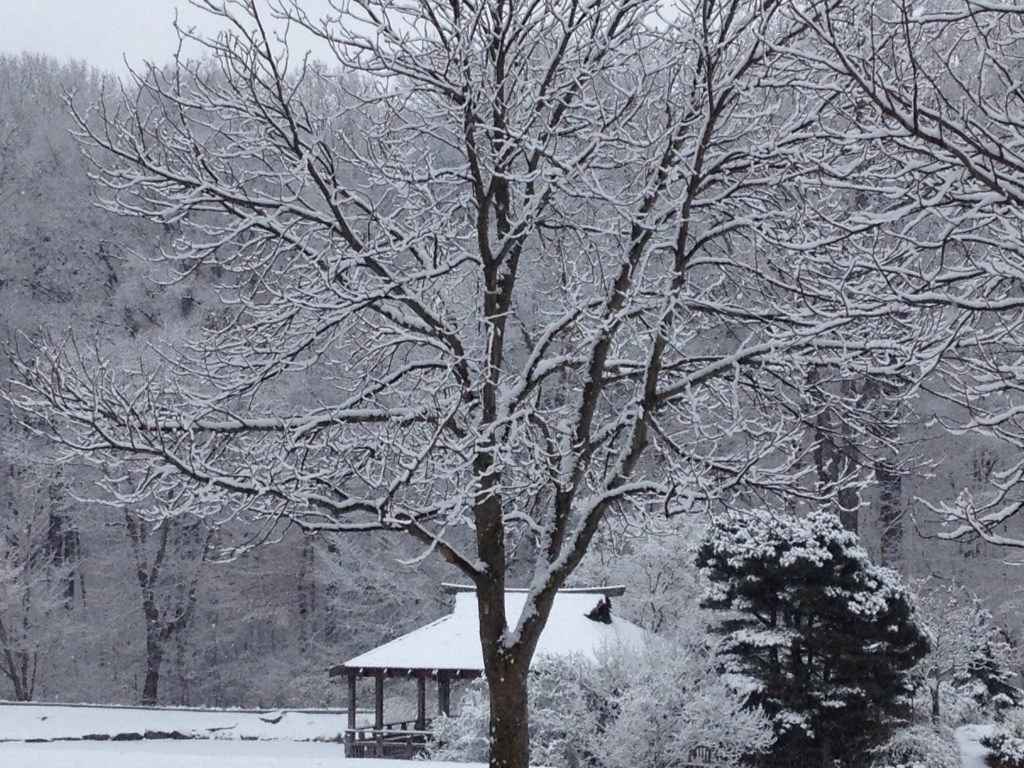
Lacy snow-covered branches at Brookside Gardens A friend of mine, Shane (of Mythical Masks), recently came up with an idea for a 12 Days of Solstice celebration, similar to 12 days of Christmas. I have copied some of his suggestions below and added or revised for my own visions as well.
I want to note that for each day, the activities listed wouldn’t have to take the whole day. They could, or could at least be the main theme of the day, but could also just be a short focus time. I know many people will still have to work on most if not all of these days. Each celebration can still be done before or after work and any other responsibilities. Ideally we’d all magically have the entire twelve days off of work and school, but then who would staff the hospitals, parks, places of worship, stores? An hour or two outside of the work day could still retain that magical feel of time out of time, I hope.
Dec 20th: Solstice Eve
Longest Night Observed. Candle Night. The traditional hymn “One Small Candle” is sung, or any candle-themed song of your choice.
https://www.youtube.com/watch?v=J02mGiWY_Ho
A tradition of turning off electric lights. Drawing into the home. Small gifts of clothes/comfort items. (Slippers, PJs, etc.) that are night related. This night is when I like to think about my year’s accomplishments, lessons, what I want to carry forward and what I want to set for goals in the next year. I write in my journal by candlelight, with all the electric lights in the house turned off and my phone set aside.
Dec 21st: Solstice Day.
Bonfires and Music! Rooted in the natural cycle of the season: the wheel turns. I create a poster each year with an illustrated wheel of the year attached, listing the main pagan celebrations– Yule, Mabon, Beltane, etc. So I literally would rotate it on this day to Yule. If I’m not able to celebrate with friends and family on Solstice Day, I might start making the next year’s wheel and poster instead. I like to include lists of the new and full moon dates, and also the dates of meteor showers, lunar or solar eclipses, and any other astronomic events.
Shane suggests that the winter solstice should be the actual New Years, as it makes the most sense to count by Solstices. However, he suggests that the 12 days be off Calendar. Time Out of Time, as was sometimes done in old traditions. I vaguely remember reading where up to a whole month was set aside out of the calendar to catch up with leap years, and that period was so far out of time that normal expectations and responsibilities were lifted. It’s an interesting concept to have a period where the normal is set aside. I think we do that today too– holiday foods are much richer and lusher than normal, but folks frequently joke, “It’s Christmas, it doesn’t count!’ The holiday season is set aside as a special time, normal expectations don’t matter. We can rejuvenate and celebrate.
Dec 22nd: Knitting Day.
Gather together for any fiber arts–knitting, spinning, crocheting– and storytelling. I read a lovely Yule Cat story on Facebook, where the enormous Yule Cat threatened to devour a town until everybody was wearing something new for Christmas, so the townsfolk all hastily knit or sewed or crocheted something, sharing materials and scraps and also sharing stories together as they worked. I think that sounds like a nice tradition to approximate in real life, albeit hopefully without the threat of being devoured. I don’t fool myself that I could create something wearable that quickly, but just coming together to knit and chat would be a cozy tradition anyway.
Dec 23rd: Kitchen/Hearth Day
On this day I propose we bake or cook holiday treats, exchange cookies, and generally spend time in the warmth and heart of the kitchen. Focus on oven-based recipes- baking & roasting. Folks who expect a large holiday gathering in the next day or two can use this time to prepare some of the needed food; those of us who aren’t hosting or even attending anything, can still fill our homes with the scents of baking goodies, roasted meats, and so forth. This would be a good day to lay in plenty of food for the next few days so we can relax and not have to cook or clean again for awhile.
Dec 24th: Reading Day
While this is traditionally known as Christmas Eve, I don’t personally have much attachment to a particular celebration. I suggest we celebrate all things reading instead. Exchange gifts of books, bookmarks, pens & paper. Write letters and cards and journals, read books. (Also electronic equivalents on your tablet, Kindle, etc.) I imagine this as predominantly an individual, private time– disappearing into the pages of fiction, personal diaries, or writing to others whom we haven’t seen in awhile. It doesn’t have to be fully alone, though– friends and families could still gather for a sort of silent reading club, sharing their home and hearth. If someone has an actual fireplace to read beside, I imagine everybody would want to visit there to snuggle up and read together. Themed refreshments or costumes could even be encouraged, if a group enjoys that kind of thing.
Dec 25th: Christmas.
Gifts exchanged between close family and friends. Again, I don’t have a personal attachment to any religious tradition for this day. No theme to today’s gifts, simply an expression of affection and/or love. For this one day, everyone’s language of love is giving and receiving gifts. (For those of us who struggle with that, though, gifts of experiences could be a good compromise. Buying someone a membership to a museum, a credit for a class of one’s choosing, tickets for a trip, that sort of thing. If the gift-giver also has the same membership it thus could double as a gift of quality time together.)
Dec 26th: Wren Day and Boxing Day
A day to acknowledge the natural world around us, particularly the birds. Inspired by the old Irish tradition of Wren Day. Going for long walks in natural settings. Walking off your Christmas dinner. Searching for Wrens to take pictures of in particular and all birds. Shane maintains a Facebook group each year for Wren Day photos. I’m in that group but so far haven’t actually gone out for a Wren Day walk. I make sure my birdfeeders are full, at least!
Also to acknowledge Boxing Day, a day of keen giving. Donating to organizations and doing Service. Today’s love language is gifts of time and money. A time to remember the most fragile animals and humans, and devote ourselves to them.
Dec 27th: Gaming Day.
Gather to play board or card games, exchange gifts of games and puzzles. Puns, riddles, jokes, pranks. Also, solo word games like crossword puzzles.
Dec 28th: Gardeners Day
On this day we plant seeds, repot overgrown houseplants, give plants to friends & loved ones, and plan the spring garden. As the sun and growing time returns, it’s also a symbolic time for us to start new projects. Planning one’s New Years Resolutions could be done on this day as well.
Dec 29th: Burrowing Day.
Spend time wrapped in blankets (in/out of bed), a cozy, dark retreat from the world, along with cuddling with loved ones. Quiet and meditative. More candles. Many roots eaten—carrots, turnips, potatoes, onions, also mushrooms. I imagine most activities are done at one’s own home on this day, rather than going out to visit others. However, it could be a lovely day to invite others to our own burrow to share movies together, or talk about our plans and resolutions for the next year.
Dec 30th: Artists’ Day
On this day everybody should engage with creativity and visual/kinetic/3D arts. Paintings, clay, playdough, dancing, singing, music, drumming. Especially make things with reused and repurposed items (a drum made out of an oatmeal carton, collages from magazine pictures, doodles on back of junk mail envelopes.) A time for making beauty and engaging one’s inner child, even if our normal selves don’t usually do this or we don’t feel like we have any “talent.” Simply playing with art, colors, dance, or music, is enough– it’s the act of making art that counts the most, not the final product.
Dec 31st: New Year’s Eve. More Bonfires and Parties. “Giving up the Old” or “Casting Away” traditions. Write down things from the past year we want to release or leave behind, and throw them into the fire. Adopting the “First Foot” by visiting friends and being the first one to enter the home on New Years after midnight.
Jan 1st: New Year’s Day. First Walk. Affirmation Day. Start the new year as we hope to continue it. Look to our new year’s resolutions for guidance– more exercise? Time with family? Better organized? Today is the day to take first actions toward those goals.
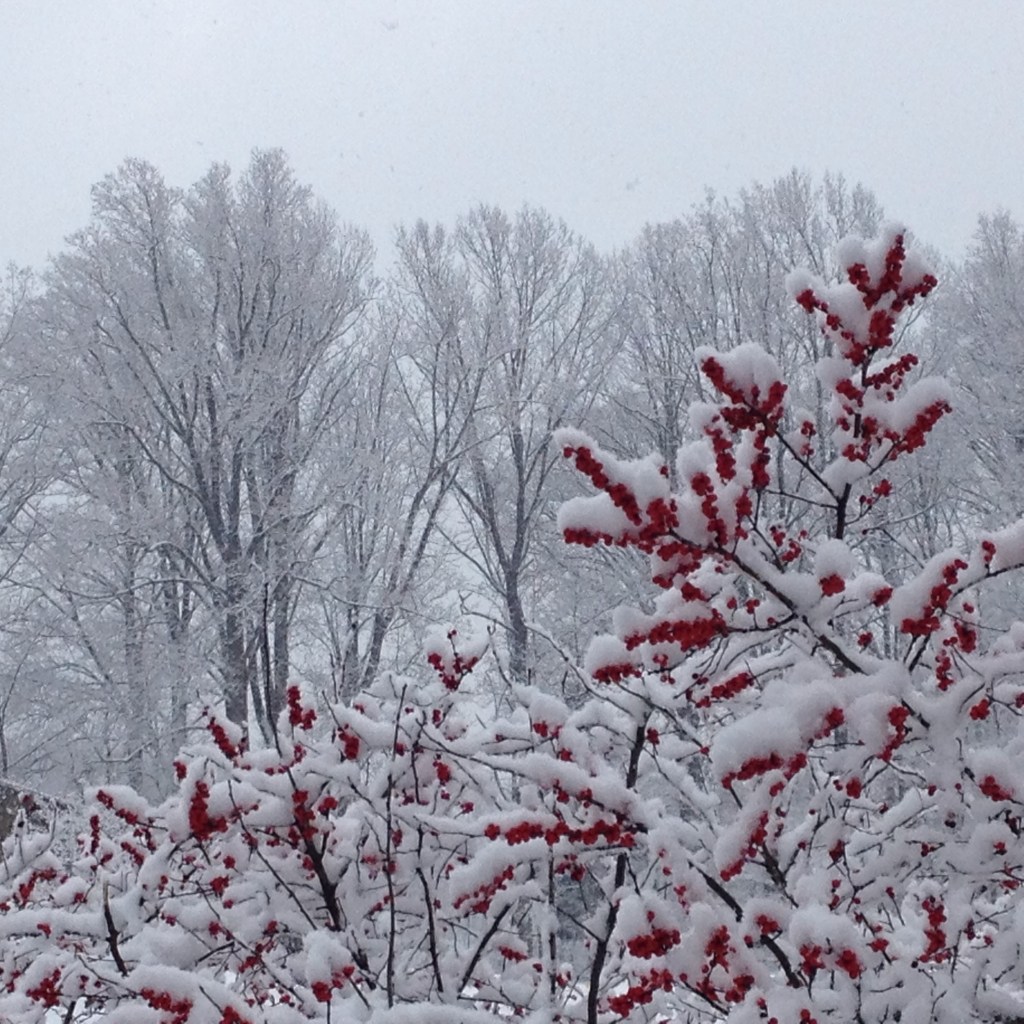
Scarlet winterberries mounded with snow, with lacy snow-covered trees visible behind them.

About Me
The sky is not completely dark at night. Were the sky absolutely dark, one would not be able to see the silhouette of an object against the sky.
Follow Me On
Subscribe To My Newsletter
Subscribe for new travel stories and exclusive content.

