
A couple weeks ago at work, one of my coworkers mentioned he had found the largest group of ground-nesting bees he’d ever seen, right behind our office. I peeked out the window but couldn’t see anything. When I went outside, though, I finally saw what he meant. There were hundreds, maybe even thousands, of little hills of earth in the dry grassy field behind our buildings. Each one had a tiny hole in it, and as I watched there were very many tiny bees flying over them, going into or coming out of them. It was so cool!
Don’t Worry
Before you start to panic on my behalf, let me reassure you. These bees had absolutely zero interest in me. I have stood in the middle of a field of ground nesting bees’ nests before, with the bees actively buzzing around me going to and from their nests, and received not a single sting or even one bee landing on me. What a lot of people think of when they imagine bees in the ground are actually wasps, yellowjackets, who have communal nests in the ground and are notoriously bad-tempered (especially when someone accidentally steps on their nest, I mean wouldn’t you be?). But these bees I encountered are truly bees.
There are a lot of different kinds of bees that nest in the ground like this. I only had my cell phone with me, so didn’t get fantastic shots. That detracted nothing from the experience, though, just meant I may not be able to identify to species level. They’re probably some kind of mining bees, family Andrenidae. They’re small, fuzzy, and won’t hurt you– basically flying teddy bears! Well, maybe that’s an exaggeration, but I still am fond of them.
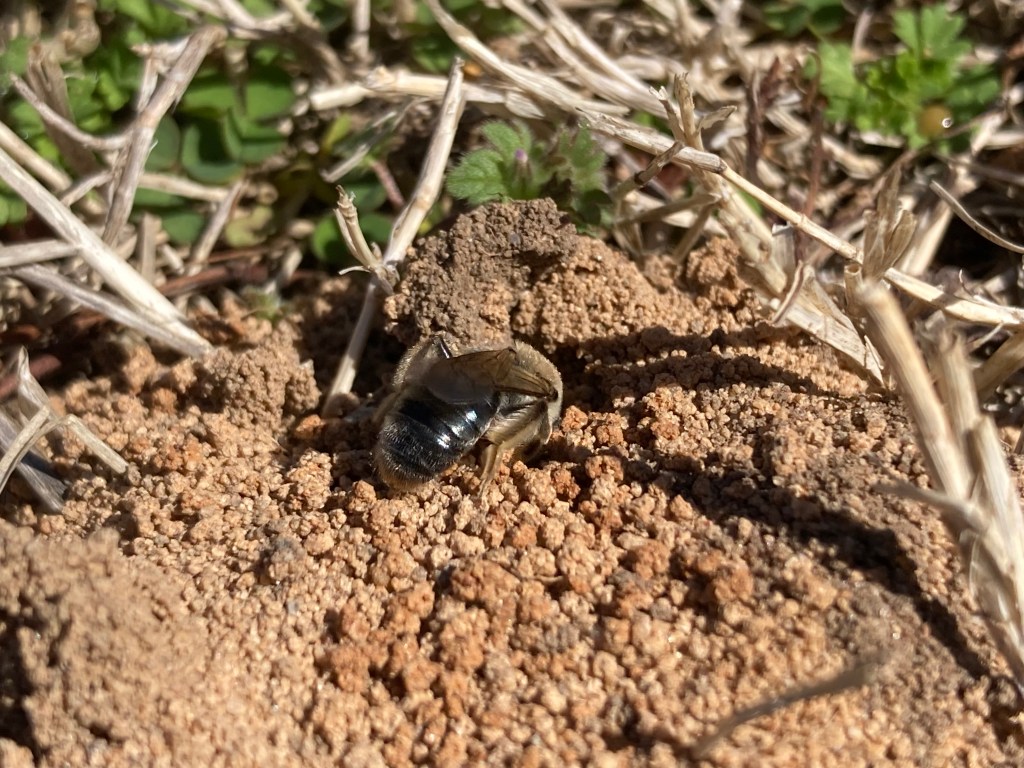
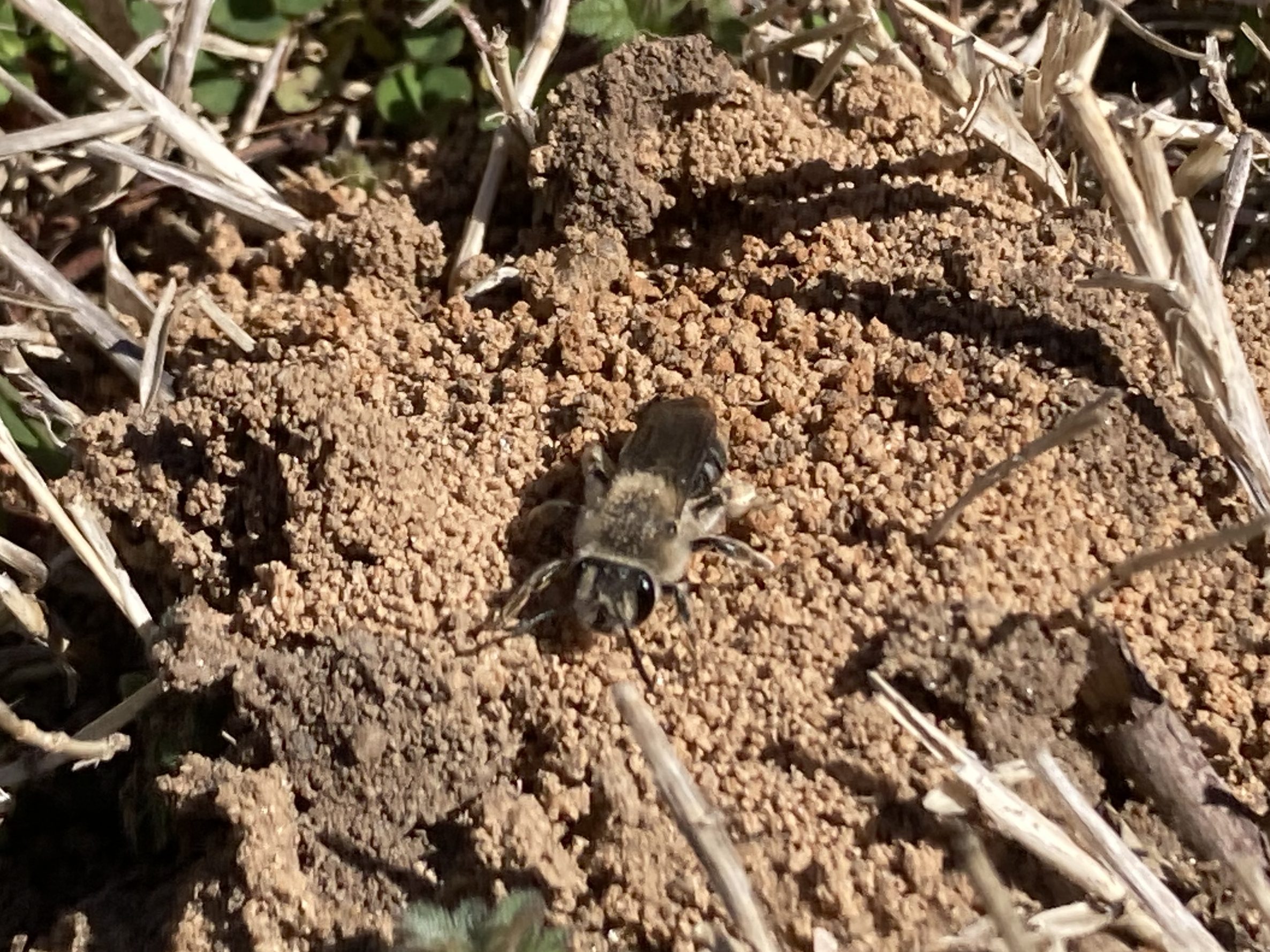
And I agreed with my coworker, I had never seen this many nests congregated before! It covered nearly the entire field behind our office buildings. I suppose it was just the right kind of soil, and the right level of moisture– and since most of the rest of the park is ponds or marsh, maybe that specific combination is not easily found. What a treat for us! And even more special, some (maybe most?) species of these bees are active for only a few weeks in the early spring. Once they’ve mated and the female has dug her burrow, and laid her egg(s) on a ball of carefully-gathered pollen, that’s pretty much it for her. The baby bee doesn’t leave larval form until early next spring.
Interdependence
And that timing is why many of the Andrenids are highly specific about what kind(s) of flower they need for pollen to feed the growing larva. There aren’t a whole lot of plants blooming yet, so early in the spring. But the kinds of flowers known as spring ephemerals are out! These are forest-floor plants that bloom only in the early spring, when the sunlight can still make it through the as-yet-unleaved branches of deciduous trees. In my area, ephemerals include Spring Beauties, Dutchman’s Breeches, Bloodflower, Virginia Bluebells, and Cutleaf Toothwort. By the time the trees are fully leafed out and cast the forest floor into shade, these plants have gone dormant again, as have the Andrenid bees. I know of at least one kind of bee in my area that’s completely dependent on a single species of flower– the Spring Beauty Bee. I have seen bees at the flowers of Spring Beauties, but I don’t know for sure whether I’ve seen that exact bee.
This year, I haven’t seen very many ephemerals blooming in my new park compared to Great Falls, which I left a few months ago; but I haven’t roamed too far beyond the ponds yet. My guess is there are more ephemerals a little further away from the pond area, where the forest is more dominant. But it’s still early, so we will see as the season progresses. (As I get ready to publish this, I’m also coming off a week and a half of being sick and cooped up in my apartment, sigh. Even if I missed the ephemerals there are still lots more blossoms to come.)
Resources
For more information about ground nesting bees, or native bees specifically in the MidAtlantic area, here are a couple places to start–
Publication from the excellent USGS Bee Lab located at the Patuxent Research Refuge in Maryland– https://www.usgs.gov/centers/eesc/quick-background-mid-atlantic-regions-native-bees
Info on a demonstration/display in California, and the life cycle & habitat needs of California ground nesting bees– https://www.miridae.com/the-ground-nesting-bee-project
 The Contented Naturalist
Leave a comment